Jensen's AI Wake-Up Call: Why America Needs to Level Up, Fast
Alright, so Nvidia's Jensen Huang just dropped a truth bomb that should have everyone from Silicon Valley to Capitol Hill chugging coffee. He basically said America needs to get its act together in the AI game, yesterday.
The core of the issue? According to Huang, half the world's AI researchers are based in China. Half! Think about what that means. That’s like showing up to a basketball game and realizing the other team already has a 50-point lead.
He wasn't just fear-mongering, though. Huang’s point is that AI is the new industrial revolution. Remember when the US dominated steel and energy? That fueled massive growth. We need to be applying AI with that same kind of speed and scale. It's not about worrying so much about robots taking our jobs (though that's a valid concern); it's about recognizing the strategic advantage AI gives us.
And how do we do that? Reskilling. That’s Huang's big push. It's not enough to just have a few brilliant engineers tinkering in labs. We need to equip the average worker with the skills to use AI tools effectively. Think about it: instead of replacing accountants, maybe we empower them with AI that can automate tedious tasks, freeing them up to focus on higher-level analysis.
I mean, look at what's already happening. I've been playing around with AI tools that can write marketing copy, generate website code, and even create music. It's not perfect, of course, but it’s getting better every single day. Imagine the potential if everyone had access to these kinds of tools and the training to use them effectively!
Huang calls this an "infinite game." There's no finish line. It’s about continuous innovation and adaptation. America's past success came from being the fastest at adopting new technologies. It's time to reignite that spirit and make sure we're not left in the dust in this AI race.
Because the alternative? Falling behind. And in a world increasingly shaped by AI, that's a risk we can't afford to take.
AI Race: US and China Neck and Neck? Nvidia's Huang Sounds the Alarm (and Praises Trump's Energy Policy)
Okay, so Jensen Huang, the Nvidia CEO, just dropped some truth bombs on Capitol Hill. He's saying the US and China are basically in a dead heat when it comes to AI chip dominance. Not behind, not way ahead... neck and neck. Think of it like this: you're running a marathon, and China's your shadow. They're right there.
And this isn't just some casual observation. Nvidia, you know, the guys who make the REALLY good AI chips everyone wants, are facing restrictions on selling their H20 chips to China. The Trump administration apparently told them they need special licenses. Some analysts are even calling it a "de facto ban". Ouch. Revenue hit incoming, probably.
But here’s where it gets interesting. Huang's also pointing out that Huawei, yeah, *that* Huawei, is becoming a major player in AI chip production. A rival, even. "They're incredible in computing," he said. "They're incredible in networking technology and software capabilities". In other words, they're not messing around.
So, what's the solution? Huang wants the US to not only ramp up chip production, which Trump's been pushing for, but also make sure those chips actually get used *everywhere*. It's not enough to just make them here; you need to get them out there. Otherwise, what's the point?
Then comes the energy policy part. Huang seems pretty happy with Trump's stance on it, saying, "Without energy, we can't possibly have new growth industries." Think about it: AI models need massive amounts of processing power. Massive processing power needs massive amounts of energy. It's like trying to bake a cake without an oven – just not gonna happen.
The restrictions on chip sales might be a way to play hardball in the trade war. The Biden administration’s framework is supposed to roll out soon, and Trump might be looking to tweak it to use chip sales as leverage. It’s all very high stakes poker.
Bottom line? The AI race is on, it’s close, and it's not just about making chips but also about the energy to power them. And Huawei? Don't sleep on them. They are officially a contender.
Meta's ChatGPT Competitor is Here (and Zuckerberg's Announcement Was Kinda Creepy)

Alright, so Meta finally unleashed its ChatGPT rival – Meta AI. And yeah, the launch was… something. Think LlamaCon, Meta's first AI developer conference, and then picture Zuckerberg hitting the big red button. This isn't just a new feature; it's a standalone app, Meta's full-on attempt to dethrone OpenAI.
Built on Llama 4, they're pitching it as *the* hyper-personalized AI assistant for anyone already trapped inside the Metaverse. We're talking WhatsApp, Instagram, Facebook – the whole shebang. But the kicker? Zuckerberg announced it in an Instagram video…wearing Meta Ray-Ban glasses. It's a voice-first experience, apparently.
The Discover feed is definitely interesting. It's basically a window into how your friends are using Meta AI, showing prompts they've tried (with their okay, of course). Meta claims you're in complete control over what gets shared. But, and this is a *big* but, opting out of having your data used to train Meta's AI? Good luck with that.
Think of it this way: it's like those Spotify playlists that show what your friends are listening to, but instead of music, it's AI prompts. Kind of cool, kind of terrifying.
The app's also designed to play nice with those Ray-Ban smart glasses. Start a voice convo through the glasses, then pick it up later on your phone or desktop. Functionally, it's the same as using it through Messenger or Instagram, but with its own slick interface. Makes sense, right?
LlamaCon wasn't just about showing off a new toy. It was a signal to investors and developers that Meta's AI ambitions are real. Remember that $60 billion Zuckerberg pledged for U.S. data centers? This is where it's going. It’s like he’s saying, "We're not messing around."
Actually, I wouldn’t be surprised if this launch pressures OpenAI to accelerate its own social-facing ChatGPT app. Sam Altman joked about it before, but now it feels inevitable. They've been dropping hints, and this Meta move might be the kick in the pants they needed. Competition is good for us users, right?
AI Experts Predict the Future: Here's What They Really Think (and How to Use It)

Alright, so everyone's got an opinion on AI these days, right? But I wanted to share something interesting. There's this new poll – I saw it the other day – that surveyed over 4,200 AI researchers from University College London. Apparently it's the biggest survey of AI folks *ever*. I mean, that's a lot of brainpower we're talking about.
There's a small catch. It was done *before* all the real craziness of the past few months with the new reasoning models. Still, gives us some valuable insights, you know?
So, generally, the researchers were either optimistic or neutral about where AI is headed. 54% said AI has more benefits than risks. About a third thought the benefits and risks were pretty even, and only a small chunk – 9% – believed the risks outweigh the benefits. Think about that. The people *building* this stuff are mostly pretty positive about it.
Let's dig a little deeper, though. What are they actually excited about, and what's keeping them up at night? On the bright side, they see huge potential in making education more accessible (75% cited this). I can totally see that, right? Imagine personalized learning experiences powered by AI, available to anyone, anywhere. Sounds amazing. They also think AI will make jobs easier (72%) – think automated tasks, better tools, less grunt work. And improved healthcare (57%) and easier household tasks (55%) were also high on the list.
But then there's the flip side. The researchers are seriously worried about misinformation and fake news (77%). This is huge. Deepfakes, AI-generated propaganda…it's a real threat. They're also concerned about our personal data being used without our consent (65%), which is totally fair. Think about all the data these AI systems are trained on… it's a privacy nightmare waiting to happen. Cybercrime (59%) is another big concern, and also AI potentially reducing social interaction (47%). That last one's interesting. Are we going to become glued to our screens, interacting only with AI assistants? I hope not.
Okay, so what does all this mean for *us*? Well, it tells me that we need to be proactive. We can't just sit back and wait to see what happens. We need to be smart about how we use AI – both for personal growth and in our businesses.
Like, what if you're in marketing? You can use AI to analyze customer data, create personalized content, and automate your campaigns. It's like having a super-powered assistant that never sleeps! You could take the AI risk of spreading misinformation to create targeted campaigns designed to engage with customers on a personal level to educate them about your brand. Just keep an eye on the ethical considerations, because with great power comes great responsibility, right?
Or if you're a freelancer, AI can help you find new clients, manage your projects, and even write proposals. It's all about working smarter, not harder. Use AI tools to research potential leads and generate compelling sales pitches. The AI risk of using personal data without consent? Use publicly available sources of information about companies and only send emails to general addresses.
The key takeaway? AI is a tool, and like any tool, it can be used for good or for bad. These researchers are optimistic for the most part, but they also see real risks. It's up to us to make sure we're using it in a way that benefits everyone.
Unlock Your Inner Artist: An AI-Powered Visual Style Generator
Okay, so you know how sometimes you have a *vibe* in mind, a very specific aesthetic you want to create, but you can't quite articulate it? Like, you want a photo that's 'steampunk meets zen garden' or '80s arcade gone gothic romance.' That's the problem this solves.
I've been playing around with a system that lets you define visual styles in detail. Think of it like creating a mood board on steroids. You can specify color palettes, textures (grainy, smooth, metallic), artistic styles (impressionism, photorealism, abstract), lighting conditions (dramatic, soft, neon), and even subject matter preferences. It's all drag-and-drop, sliders, and text input. Seriously, super intuitive.
But here's the cool part. Once you've defined your visual style, the system uses AI to translate it into a text prompt optimized for image generation. I'm not talking about just throwing in a few keywords. This is an AI crafting a nuanced prompt designed to capture *exactly* the look you're going for. It takes all those parameters and mashes them up into something coherent the AI image generator can understand. It's pretty wild.
Then, BAM! It uses that prompt to generate an image. You've probably seen AI image generators before. But the key is that now you have control beyond just writing a sentence and hoping for the best. You're *directing* the AI with a style that you've meticulously crafted.
And it doesn't stop there. The system automatically saves the images, along with your style definition and the generated prompt, to an online database. Think of it as your personal library of awesome AI-generated visuals.
Why is this so huge? Because now you have a centralized repository of unique images that perfectly match your brand or personal style. Need a stunning graphic for your Instagram post that feels consistent with your overall theme? Boom, just pull it from your database. Want a killer Facebook ad image that screams 'your brand'? There it is. Creating a consistent, professional visual identity across all your social media platforms just got a whole lot easier. No more generic stock photos – these are 100% unique to *you*.
I'm imagining using this for so many things. A friend of mine is using this to generate assets for their D&D campaign based on the campaign setting. I'm currently using this to create mood boards and inspiration images for my house renovation. Plus, for business owners, imagine how much time and money this could save you on design work. You can pump out visuals on demand without relying on expensive designers or struggling with clunky design software. You're essentially outsourcing your graphic design to a smart AI tool that understands your brand's aesthetic better than anyone.
This isn't just a cool AI toy; it's a productivity weapon. It's a way to harness the power of AI to unlock your creative vision and build a stronger, more visually compelling presence online. Give it a try and let me know what you think!
Are You Commanding the Robot, or Becoming One? Using AI to Stay Human

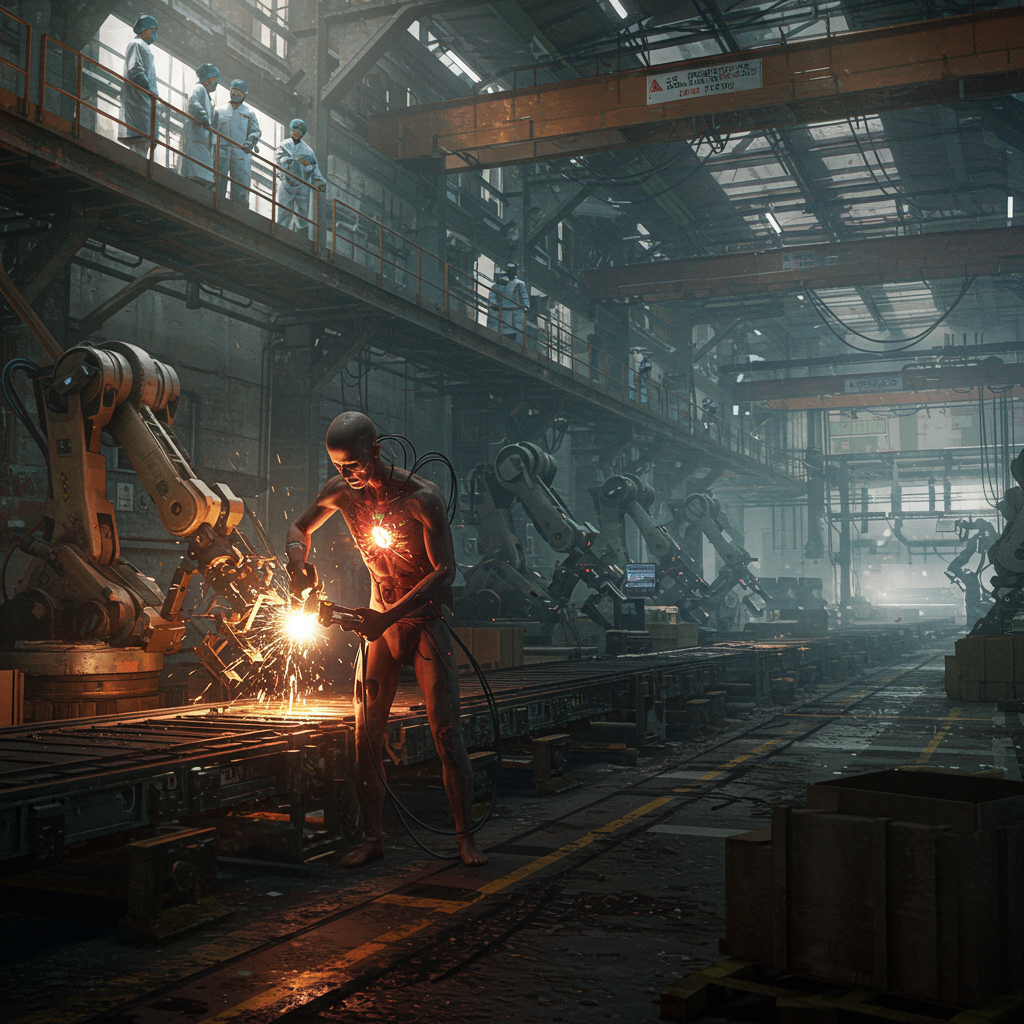
Someone dropped this quote recently, and it really stuck: "There’s a big difference between a factory job where you command the robot and one where you are the robot." It hits hard, right? Especially now, with AI weaving itself into pretty much everything we do.
It’s easy to see the scary side, the potential for jobs to become hyper-optimized checklists where *we* are just executing tasks dictated by an algorithm. Think about those warehouse pickers timed down to the second by software, or customer service reps following rigid scripts generated on the fly by AI. That feels a lot like ‘being the robot’ – efficient maybe, but draining, repetitive, and stripping away the human element, the judgment calls, the creative problem-solving.
But here’s the thing, especially for those of us looking for ways to work smarter and grow: that's not the *only* path. The other side of that quote – commanding the robot – is where the real opportunity lies. And that’s exactly what we talk about here: using AI as a tool, as leverage, as a way to amplify *your* skills, not replace them.
So, what does ‘commanding the robot’ actually look like with today's AI? It’s less about physical robots (usually) and more about directing AI software.
Think about it:
- Instead of manually sifting through hundreds of customer feedback forms, you use an AI tool to summarize the key themes and sentiment overnight. You command the AI to do the grunt work, freeing you up to actually strategize based on the insights.
- Stuck on drafting a tricky email or a marketing blurb? You bounce ideas off ChatGPT, asking it for different angles, tones, or structures. It’s like having an incredibly fast, tireless brainstorming partner. You're directing the creative process, using AI output as raw material, not the final word.
- Need visuals for a presentation fast? You use an AI image generator with specific prompts to create exactly the kind of illustration you need in minutes, rather than spending an hour scrolling through stock photos that are *almost* right. You are the art director, guiding the AI's creation.
- Overwhelmed by meeting notes? Use an AI transcription and summarization tool. It captures the details, you focus on the conversation and the key takeaways. You command the AI to handle the note-taking, improving your presence and follow-up.
See the pattern? In each case, you're not just executing a task. You're identifying a need, choosing the right AI tool, and directing it to achieve a specific outcome that helps *you* do *your* job better, faster, or more creatively. You’re offloading the repetitive, the time-consuming, the stuff that drains your energy, so you can focus on higher-level thinking, strategy, and the uniquely human skills that AI (currently) can't replicate.
This isn't about some far-off future; these are practical AI hacks you can implement *now*. It’s a conscious choice. Are you going to let technology dictate your workflow until you feel like a cog? Or are you going to actively find ways to grab the controls and make AI work *for* you?
Being the commander means staying curious, experimenting with new tools, and constantly asking: "How can this technology help me achieve my goals, rather than just adding another task to my list?" That's how you use AI for genuine growth, staying firmly in the driver's seat.